
An Interview with J. Anderson Coats, author of The Unexpected Lives of Ordinary Girls
Please tell us about The Unexpected Lives of Ordinary Girls.
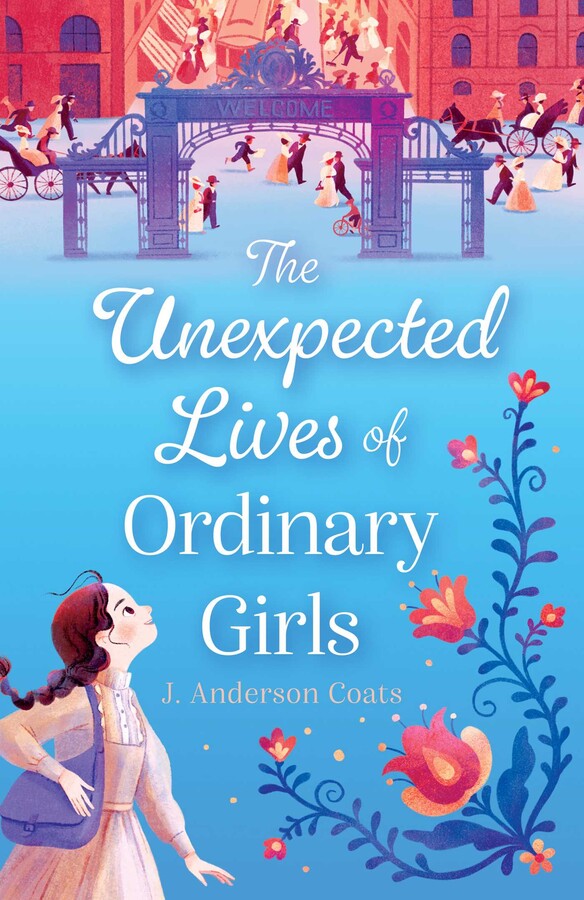
The Unexpected Lives of Ordinary Girls is set in Colorado in 1910, and it’s about a girl named Stanislava who’s growing up in a working-class Slovenian-American community. While she loves her big traditional family, she often feels stifled by the expectations placed on her.
When she finds a book at the penny library about an immigrant girl from a poor family who goes to college, Stanislava has a new set of hopes and goals to reach for. Here is someone like her with a future she wants. She decides to change her name to Sylvia so she feels like she’s moving herself toward that future.
But when her older sister Stina abruptly elopes and leaves town, Sylvia learns that her parents expect her to quit school and help her mother full time with the housework and child care the way Stina has always done.
There’s only one person who might help Sylvia avoid this fate, and that’s Stina. Stina knows what it feels like to be stuck elbow-deep in dishwater and surrounded by screaming siblings. But when Sylvia’s plan to find her sister doesn’t go quite as she expected, she’s got to decide whether to go home and face the music—or find a way to make her way on her own.
What is the story behind this story? (I know you have a personal connection.)
My grandmother helped take care of me pretty much every day when I was growing up. She didn’t like to talk about her childhood much, although I was the kind of curious kid who wanted to hear those kinds of stories. I knew some basic things—notably that her parents were immigrants from the region that eventually became Slovenia—but it wasn’t until after she passed away that I learned some grittier things.
One of them was how she always loved school and graduated from high school in her mid-teens, but her father wouldn’t let her get a job outside the home. College was absolutely out of the question, partly because of money, but also her father thought she’d had enough education. He expected her to do housework for the family until she got married. That was the only way out.
Obviously I was upset at my great-grandparents on her behalf, but mostly I started to imagine how it would feel to be in that situation. To be excited about school and reading and learning, but to be firmly put in your place by someone who didn’t care what you wanted.
So I created this character to explore that stuck feeling, and as I wrote, I realized how so many modern kids would relate to a situation where you want one thing while your parents want something different for you, particularly when the differences are cultural as well as generational. So I decided to lean into those commonalities.
You have written an number of middle grade and YA novels, almost all of them historical fiction. In fact, Booklist once called you a “historical fiction master.” What draws you to historical fiction? What keeps you coming back?
Mostly I keep coming back because there’s a certain section of the population that really, really doesn’t want people to read, consider, and grapple honestly with historical events in their raw, real form.
These people especially don’t want kids to explore and work toward an understanding of history that doesn’t center the particular version of the past they wish existed, or that they need to fabricate in order to prop up their vision of what the future ought to look like.
Our shared human past is far from perfect. There’s a lot that’s hard to learn about, to know about. It can be deeply unsettling to sit with the idea that you benefit from other people’s dispossession and marginalization, whether you want to or not, and how events from years past contribute to systems and mindsets that govern our current reality.
But when young people learn history in an honest way, developing differences in perspective that encourage them to challenge those entrenched systems, they are better equipped to notice when they’re being manipulated with half-truths and misrepresentations deployed by those who want to control the narrative and steer it in a direction that benefits the powerful at the expense of everyone else.
Historical fiction has the advantage of activating the storytelling nature of history in a way that makes the past feel immediate, relevant, and engaging. There’s something powerful in knowing that gives kids tools to recognize who they are and who they want to become.
What are some differences you’ve found in writing for different audiences?
Honestly? Not a lot. Both kids and teens are more than capable of handling ambiguity and complexity, and they engage thoughtfully with difficult subject matter. I suppose the main difference is in intensity. It’s not about pulling punches as much as it is the way you handle a subject or event that makes it comprehensible.
Learn more about Jillian and her books at jandersoncoats.com.