non-fiction

  • | | | | |

    Classroom Connections: Small Shoes, Great Strides by Vaunda Micheaux Nelson

    age range: grades 2-5
    genre / format : narrative nonfiction; picture book
    topics: school integration; Civil Rights Movement
    Vaunda Micheaux Nelson’s website

    Micheaux Nelson and Bostic’s information-packed picture book examines an overlooked story of civil rights . . .[An] affirming look at “three unlikely leaders in small shoes” who “took great strides.”
    — Publisher’s Weekly, starred review

    An unmissable story about everyday courage whose notes about the importance of overcoming discrimination remain timely.
    — Foreword, starred review

    A welcome spotlight on the undersung history of three girls whose bravery and endured torment carved a path for generations.
    — Booklist, starred review

    What a treat to interview my dear writing friend and critique group member, Vaunda Micheaux Nelson. Vaun, please tell us about your book.

    Small Shoes, Great Strides: How Three Brave Girls Opened Doors to School Equality is a nonfiction picture book about public school desegregation in New Orleans.  Escorted by United States Marshals, first graders Leona Tate, Tessie Prevost and Gail Etienne made history on November 14, 1960 by bravely entering the previously all-white McDonogh 19 Public School amidst ugly protests.  It was an important step in the struggle for fairness in education.  The significance of simply going to school was not understood by them at the time and, for decades, the women didn’t speak much about it.  In recent years, the McDonogh Three (as they came to be known) have begun to talk, and I am honored to help share their story.

    What inspired you to write this story?

    I love history, specifically under-told stories in black history.  I am especially attracted to fascinating contributors about whom I know nothing, whose stories compel me.  Learning that the McDonogh Three entered their school on the same day as Ruby Bridges made me ask, “Why didn’t I know about Leona, Tessie and Gail?”  When I realized they integrated McDonogh 19 ten minutes prior to Ruby Bridges at Frantz Elementary, I was even more intrigued and so resolved to tell their story.  All due respect for Ms. Bridges’ accomplishments and contribution, I feel discrepancies in history should be acknowledged and corrected.  I hope I accomplished this. 

    Could you share with readers how you conducted your research and / or share a few interesting tidbits about your writing process with this book?

    Being able to meet and interview Leona, Tessie, Gail and retired U.S. Marshal Herschel Garner was unforgettable.  I was blessed to hear this story from the individuals who lived it, and I’m indebted to them all for their generosity.  In addition to interviews, I used books, newspaper and magazine articles, audio and video resources, Orleans Parish School Board minutes and other school documents.  The fact that hurricane Katrina destroyed considerable New Orleans school district records, as well as many personal artifacts belonging to my subjects, complicated and frustrated my research.  As to the writing process, after immersing myself in the material, I construct the story line to be as straightforward and accessible for my target audience as possible.  I employ back matter to expand on the information without having to interrupt the primary narrative.  This allows more advanced readers to satisfy their curiosity for what broadcaster Paul Harvey called “the rest of the story.” 

    What topics does your book touch upon that would make it a perfect fit for the classroom?

    • school desegregation
    • the Civil Rights Movement
    • discrimination
    • the U.S. Marshals Service
    • education
    • Brown vs. Board of Eduation
    • separate but equal

    Here’s a fabulous interview Vaunda recently did about Small Shoes with The Horn Book’s Roger Sutton.

  • | | | |

    Straight from the Source: Elizabeth Brown on Writing Historical Picture Book Biographies

    Elizabeth Brown‘s debut picture book, DANCING THROUGH FIELDS OF COLOR: THE STORY OF HELEN FRANKENTHALER, was published by Abrams Books for Young Readers, and it was a New York Public Library Best Books of 2019, a Junior Library Guild Selection, a Society of Midland Authors 2020 Awards – Children’s Nonfiction Honoree, and A Mighty Girl 2019 Book of the Year. LIKE A DIAMOND IN THE SKY: JANE TAYLOR’S BELOVED POEM OF WONDER AND THE STARS (Bloomsbury) released in 2022, and THE WORLD ENTIRE: THE UNTOLD TRUE STORY OF EXTRAORDINARY RESCUE FROM WORLD WAR II releases in Fall 2023 (Chronicle Books) with additional titles following. Elizabeth earned her MFA in Creative Writing from Goddard College. She is a member of SCBWI and is represented by Sean McCarthy Literary Agency. You can connect with her at www.elizabethbrownbooks.com and on Twitter @ebrownbooks.

    What typically comes first for you: a character? An era? A story idea? How do you proceed from there?

    Usually a character comes first for me. Since I have been writing biographies, it’s the subject of the biography that comes to me. Before I get too attached to this figure, I really start my research right away to see if there is a great story to tell and to figure out the way I might want to tell it. Once this is clear, I can officially commit to the writing of the book after I have completed my research. 

    How long do you typically research before beginning to draft?

    I research for a long time before beginning to draft. It varies how long, depending on what I am looking for and how long the project is. The average time is maybe about 6 months. When I have been able to plot and outline the story and feel ready to start drafting, I do. For my research for both Dancing Through Fields of Color and Like a Diamond in the Sky, it took approximately 4 months of research prior. One of my forthcoming historical picture book biographies, The World Entire, took much longer and a couple middle grade nonfiction projects have taken, on average, 1-2 years of research.

    What is your favorite thing about research?

    My favorite thing about research is when I learn interesting, little known facts about my subject, and when I find out one of these hidden gems will make the story soar. When this happens, it makes me very happy! This usually always happens in my research phase, and I encourage all writers to remain open to seeing your story in new ways throughout the process of research, plotting, and drafting. You never know where your story will take you! 

    What’s your favorite thing about writing biographies?

    When I get to shine a light on an unsung hero or a historical figure who should be known, it is rewarding. This is my favorite thing about writing biographies. I enjoyed learning so much about Helen Frankenthaler when I wrote Dancing Through Fields of Color. There were so many interesting facts about her life, and threading those most special details into the fabric of the story was both enriching and challenging. Similarly, telling the little known story of how the song “Twinkle, Twinkle, Little Star” came to be one of the best known lullabies was also such a fascinating experience. Jane Taylor’s struggle to write in a time when women writers were ignored and often had to hide their true identities in order to publish will hopefully serve to inspire young writers everywhere. 

    Why is biography important?

    Biography is important because it can be motivating and educational for young readers to read about figures who may inspire them in their own lives. There is no greater reward for me as writer! I have additional forthcoming biographies as well as I’m currently working on seven other books and two films. Even though I write in other genres at times, biographies, especially picture book biographies, are my favorite to write. I enjoy sharing my books with readers everywhere!

  • | | | | |

    Straight from the Source: Glenda Armand on Writing Historical Fiction and Nonfiction

    Glenda Armand is a retired teacher and librarian. She is the author of picture book and chapter book biographies and historical fiction. Glenda’s newest book, Black-Eyed Peas and Hoghead Cheese: A Story of Food, Family and Freedom, released in September from Crown Books for Young Readers. Visit Glenda online at glenda-armand.com.

    What is your favorite thing about writing biographies and historical fiction?

    When I write biographies and historical fiction, I enjoy being all-knowing and all-seeing!

    I like having the subject’s entire story laid out before me from beginning to end. With that, I can find themes and evaluate events in the light that hindsight shines on them. I can emphasize the events that proved to be significant milestones. 

    I would not want to write a story about current events or a famous person alive today. Before I start a book, I need to know how the story ends.

    What typically comes first for you? An era? A story idea?

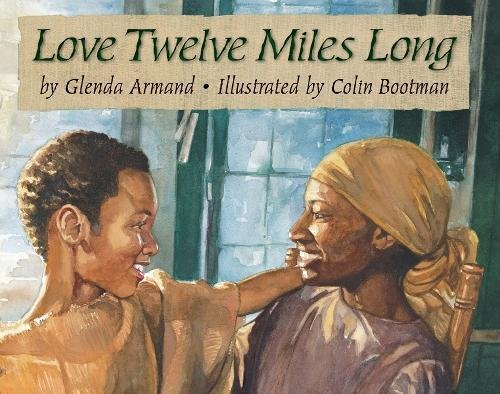
    How an idea arrives is different for each book, which is one of the joys of being a writer. As a student of American history, I am particularly interested in the Revolutionary and Civil War eras, so ideas will often come to me while I am reading books from those time periods. For instance, while researching Frederick Douglass for my first book, Love Twelve Miles Long, I discovered African American Shakespearean actor Ira Aldridge, who became the subject of my second book, Ira’s Shakespeare Dream. 

    However, my latest book, Black-Eyed Peas and Hoghead Cheese: A Story of Food, Family and Freedom came about in a completely unexpected way. I was not reading about the Boston Tea Party or the Underground Railroad when the idea for the book came to me. Black-Eyed Peas and Hoghead Cheese, although so personal to me, was not even my idea.

    The concept for Black-Eyed Peas arrived in an email. My agent informed me that an editor at Crown Books was looking for someone to write a picture book about soul food. Would I be interested? 

    I did not jump at the chance because, I must confess, I am not a foodie. However, my family is from Louisiana, and I grew up eating delicious Creole cooking. With that experience and picture books being in my wheelhouse, I thought I would give it a try. Perhaps an “outsider looking in” perspective might work.

    Once you’ve gotten the idea, how do you proceed from there?

    The first thing I do after getting an idea for a book is to search online for any other children’s books that may have been written on the topic. Sometimes, I find that the idea is not unique after all. If there are already several children’s books on the historical figure or topic, I might decide to pass. Or I might decide that I can add a different perspective. 

    Many books, including children’s books, have been written about Frederick Douglass, but I thought that Love Twelve Miles Long, with its focus on Frederick Douglass’s mother, did have something to add to the genre. 

    If I decide to go ahead with a book, I check my personal library to see what books I already have on the topic. I research online and I look for reference books that I might want to buy. Even though I am writing historical fiction for children, I rarely use fiction or children’s books for research. I just want facts and not someone else’s interpretation of the facts. It’s my job to put my own spin on the topic. And I don’t want to inadvertently appropriate someone else’s idea!

    For Black-Eyed Peas, I didn’t start my research in the usual way. This book was going to be, in a sense, about me. So I began by making a list of some of the foods my mom used to cook. Gumbo, black-eyed peas, jambalaya, sweet potato pie, pralines—and the dreaded hoghead cheese. I interviewed the cooks in my family. Then I researched each food item that I chose to highlight in my book. I wanted to find out how it became a part of my family’s tradition and African American/Creole culture.

    Because life isn’t always clear cut, the motives behind our actions don’t always make sense. But stories need to follow a logical path. What sorts of decisions have you had to make about “muddy” historical figures or events in order for your book to work?

    One book instantly comes to mind in answer to this question. Song in a Rainstorm: The Story of Musical Prodigy Thomas “Blind Tom” Wiggins has been the hardest book for me to write. When I learned about Blind Tom over a decade ago, I was immediately fascinated by his story. He was an African American, born into slavery, who became a musical prodigy. Even more incredible, Tom Wiggins was born blind and autistic. 

    It would be a difficult story to tell because, although there were kind people who helped him realize his true potential, there were many bad actors in Tom’s life. How to tell his story? And tell it as a children’s picture book at that! How could I tell it without seeming to dismiss the cruelty of slavery and exploitation, and the realities of having disabilities? His life story was definitely “muddy,” but I knew that it was a story that should be told. I lived with the story for over ten years before I started writing it. 

    I believe I finally found a way to tell his story, keep the focus on him and his incredible talents, while acknowledging the sad circumstances of his life. Albert Whitman published Song in a Rainstorm in 2021. 

    With Black-Eyed Peas, I again had to acknowledge the evil of slavery, while honoring the resourcefulness, bravery, and resilience of the enslaved. The task is not as daunting when your primary goal is to tell the truth. And when the enslaved are your own ancestors, your own family, you make sure that their humanity, their individuality and their love come through.

    What is your favorite thing about research?

    I enjoy learning. So when I first dig in to my sources, that is when the fun begins. There is always more to learn about a subject; even when the subject hits close to home. When I wrote Black-Eyed Peas, I learned many things about the history of my own family, the Creole culture, and African Americans in general. I learned how deep my family’s roots are in Louisiana, while gaining a deeper understanding of how intricately the story of African Americans is entwined with the history of the United States. I grew to appreciate the extent to which what we eat makes us who we are. 

    What do your want your young readers to take from Black-Eyed Peas and Hoghead Cheese?

    I hope the Black-Eyed Peas encourages young readers to learn more about their own family traditions. I hope they will “interview” family members and learn about their heritage and how their culture is a part of the great tapestry that is American culture. And, also, I hope they learn how to cook!

    Keep an eye out for Glenda’s next book, All Aboard the Schooltrain, releasing next January.